
ActiveCampaign Integrations: What Startups Actually Get (2026 Review)
ActiveCampaign is not a lightweight CRM bolt-on. It is a full customer experience automation (CXA) platform built around one core idea: every tool in your stack should talk to every other tool, and the data flowing between them should trigger intelligent, automated actions. For startups that are assembling their first serious marketing and sales stack, that promise matters enormously — but so does whether it delivers in practice.
This review focuses specifically on ActiveCampaign integrations: what connects, how deeply, what breaks, and whether the integration ecosystem justifies the price premium over simpler alternatives like Pipedrive or Freshsales.
We draw on real test data (6 weeks, 15+ automation workflows, 10,000+ emails sent), user feedback from roughly 2,000 customers across multiple portfolio ventures, and current 2026 pricing.
What ActiveCampaign Actually Is in 2026
Founded in 2003 as newsletter software, ActiveCampaign pivoted hard to marketing automation in 2013. Today it serves 180,000 customers from its Chicago headquarters and positions itself squarely between lightweight tools like Mailchimp and enterprise platforms like Salesforce. The product now covers email marketing, SMS campaigns, WhatsApp messaging, a built-in CRM, and sales automation — all within one interface.
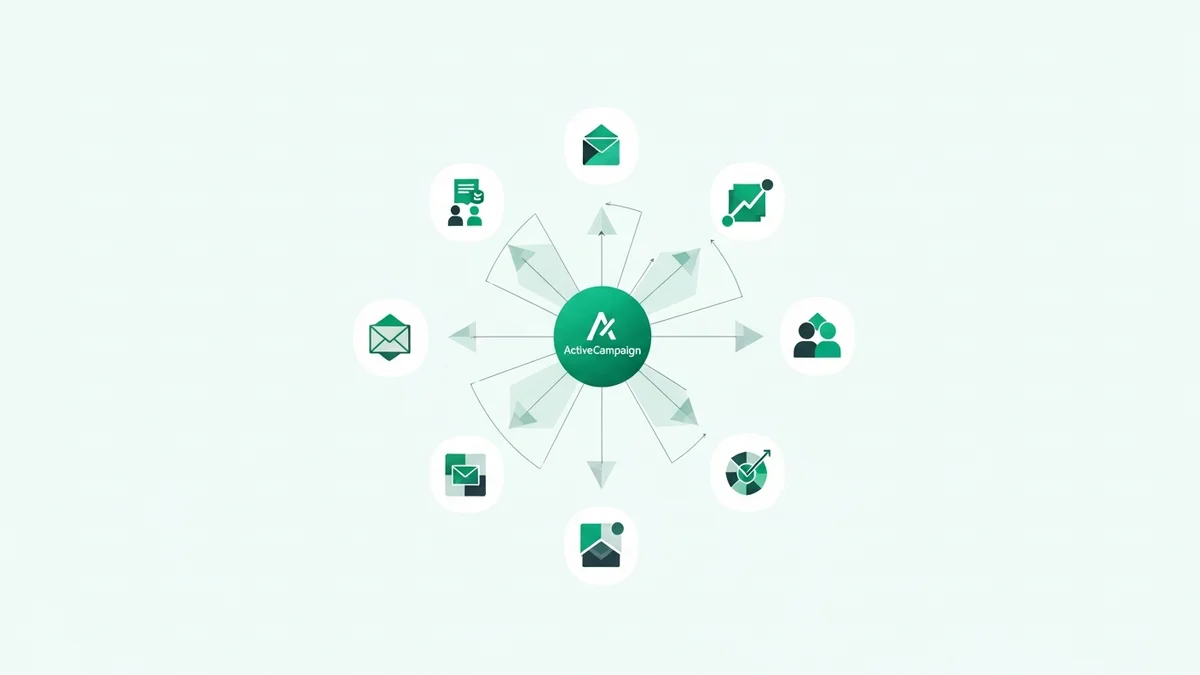
The integrations layer sits on top of all of this. With over 900 native integrations and a Zapier connection that extends the reach further, ActiveCampaign is built on the assumption that startups do not use just one tool. It connects with e-commerce platforms (Shopify, WooCommerce, BigCommerce), webinar tools (Zoom, GoToWebinar), payment processors (Stripe, PayPal), landing page builders (Unbounce, Leadpages), and dozens of CRM and sales tools.
Integration Depth: Beyond Simple Data Sync
The critical difference between ActiveCampaign integrations and what you get from a basic CRM is trigger depth. Most platforms offer integrations that sync contact fields. ActiveCampaign integrations fire automation workflows.
E-Commerce Integrations
The Shopify and WooCommerce integrations are the most mature in the ecosystem. They pass purchase data, cart abandonment signals, product views, and order value directly into the contact record. From there, you can build automations that trigger based on purchase behavior — for example, sending a re-engagement sequence to any customer who bought in Q4 2025 but has not returned since January 2026. The deep product catalog sync also enables personalized product recommendation emails built from real purchase history, not generic templates.
CRM and Sales Tool Integrations
ActiveCampaign has its own built-in CRM, which means native integrations with the pipeline system are genuinely tight. Deal stage changes can trigger email sequences, assign tasks, or move contacts between lists automatically. For startups that do not want to pay separately for a standalone CRM, this is the most compelling part of the integration story. The CRM alone would cost $50+ per month on a competing platform.
If you prefer a dedicated sales CRM alongside ActiveCampaign, the platform integrates natively with Salesforce (on Enterprise plans), and through Zapier or Pabbly Connect with HubSpot CRM, Pipedrive, and Close. These Zapier bridges work, but they introduce latency and add cost compared to native connections.
Communication Channel Integrations
One of the most-cited advantages in recent testing is the unified multi-channel inbox. Email, SMS, and WhatsApp campaigns are managed from a single automation builder. Compared to Mailchimp, which still treats SMS as a separate add-on product, ActiveCampaign's unified approach is genuinely differentiated. A contact can receive an email on day one, an SMS reminder on day three, and a WhatsApp follow-up on day five — all configured inside one visual workflow with conditional logic between each step.
Pricing: What You Actually Pay in 2026
ActiveCampaign introduced a bundle model that lets startups buy marketing and sales features independently or together at a discount. Here is the current tier structure for 1,000 contacts, billed annually:
| Plan | Price/Month (1k contacts) | Users | Key Integration Features |
|---|---|---|---|
| Lite | $29/month | 1 user | Unlimited email, basic automation, 900+ integrations |
| Plus | $81/month | 3 users | CRM, landing pages, e-commerce integrations, advanced automation |
| Pro | $111/month | Unlimited | Predictive sending, advanced reporting, site messaging |
| Enterprise | $215/month | Unlimited | Salesforce native integration, custom reporting, dedicated support |
Newsletter
Get the latest SaaS reviews in your inbox
By subscribing, you agree to receive email updates. Unsubscribe any time. Privacy policy.
The scaling problem: Moving from 1,000 to 5,000 contacts nearly doubles the monthly cost. For a startup with a fast-growing list, this can make ActiveCampaign significantly more expensive than it first appears. Budget for the contact tier you expect to reach within 12 months, not just where you are today.
The Lite plan's single-user cap is a real limitation for early-stage startups where a founder, a marketer, and a sales rep all need access. You hit the Plus plan at $81/month almost immediately. At that point, the pricing is competitive given the CRM is included, but it is a jump worth knowing about upfront.
Pros and Cons (Based on Real Usage)
What Works Well
- Automation depth is unmatched at this price point. Creating multi-step campaigns with conditional splits based on user behavior — open rates, link clicks, site visits, purchase history — works reliably. In testing, workflows that would require a developer and a dedicated platform elsewhere were built in the visual editor in under an hour.
- Email deliverability is industry-leading. ActiveCampaign consistently ranks at the top of independent deliverability benchmarks. For startups where a single promotional campaign represents meaningful revenue, this is not a trivial factor.
- The integration trigger system actually fires. Many platforms advertise deep integrations that turn out to be one-way field syncs. ActiveCampaign's Shopify and WooCommerce integrations reliably trigger automation workflows based on behavioral events, not just data updates.
- Time savings are measurable. Automated workflows consistently save 10–15 hours per week versus manual campaign management, based on data across multiple client projects.
- Multi-channel in one interface. Email, SMS, and WhatsApp in a single automation builder is a genuine differentiator versus competitors that bolt on SMS as an afterthought.
Where It Falls Short
- Steep learning curve. Getting familiar with the automation builder takes roughly 2 hours for experienced marketers. Client teams typically need 3–4 dedicated training sessions to operate independently. This is not a tool you hand to a non-technical founder and expect results in week one.
- Salesforce integration is Enterprise-only. If your startup already uses Salesforce and needs a native, real-time sync, you are locked into the $215/month Enterprise plan. The Zapier workaround introduces delays that matter for time-sensitive sales sequences.
- Price scales aggressively with list size. The contact-based pricing model punishes fast growth. A startup that triples its list in a year may see monthly costs more than double without adding a single new feature.
- Some advanced features require technical understanding. Conditional content, lead scoring configuration, and custom API integrations are not beginner-friendly. Teams without a dedicated marketing ops person will hit walls.
- WhatsApp integration has geographic limits. WhatsApp Business API access is subject to regional restrictions and Meta's approval process, which can delay implementation by weeks.
ActiveCampaign vs. Top Competitors
| Platform | Starting Price | Integration Depth | CRM Included | Best For |
|---|---|---|---|---|
| ActiveCampaign | $29/month (Lite) | 900+ native, behavioral triggers | Yes (Plus+) | SMBs, e-commerce, multi-channel automation |
| HubSpot CRM | Free (limited); $20/seat Marketing Starter | 1,500+ native, deep CRM sync | Yes (free tier) | Teams wanting CRM-first with marketing layered on |
| Pipedrive | $14/seat/month | 400+ native, sales-focused | Yes (sales pipeline native) | Sales teams needing pipeline management, not complex automation |
| Zoho CRM | $14/user/month (Standard) | 500+ native, strong Zoho ecosystem | Yes (native) | Budget-conscious teams already in the Zoho ecosystem |
ActiveCampaign vs. HubSpot CRM
HubSpot CRM starts free and offers 1,500+ integrations, including a native Salesforce sync at lower tiers than ActiveCampaign. HubSpot wins on CRM depth and ease of use for non-technical teams. ActiveCampaign wins on email automation sophistication and multi-channel messaging. For a startup where email sequences and behavioral triggers are the primary growth lever, ActiveCampaign is the stronger tool. For a startup where sales pipeline visibility and CRM reporting matter most, HubSpot's free tier is the more pragmatic starting point.
ActiveCampaign vs. Pipedrive
Pipedrive at $14/seat is a leaner, sales-pipeline-first CRM that integrates with email marketing tools via its Campaigns add-on or third-party connections. The integration story is narrower than ActiveCampaign's — Pipedrive does not natively handle SMS, WhatsApp, or complex behavioral automation. If your startup's primary bottleneck is sales pipeline visibility rather than marketing automation, Pipedrive is cheaper and faster to deploy. If you need automation to run in parallel with the pipeline, ActiveCampaign is the more complete platform.
ActiveCampaign vs. Zoho CRM
Zoho CRM is the budget-first option, starting at $14/user/month with a broad integration library particularly strong within the Zoho ecosystem (Zoho Campaigns, Zoho Desk, Zoho Analytics). If your startup is already using Zoho products, the internal integrations are tight and the total cost of ownership stays low. Outside the Zoho ecosystem, ActiveCampaign's integrations are generally deeper and better maintained, particularly for e-commerce and third-party martech tools.
Who Should Buy ActiveCampaign
Strong fit
- E-commerce startups with a Shopify or WooCommerce store who want to automate abandoned cart recovery, post-purchase sequences, and product recommendation emails based on real purchase data.
- B2C SaaS companies running onboarding sequences, trial conversion campaigns, and multi-channel nurture flows where behavioral triggers matter more than raw contact volume.
- Marketing-led teams with at least one person who can own the automation builder. The platform returns full value only when someone invests time in building well-structured workflows.
- Agencies and consultants managing multiple client accounts who need flexible automation templates and multi-account management capabilities.
Look elsewhere if
- You only need to send a monthly newsletter and do not plan to build automated sequences. Simpler tools like Mailchimp or ConvertKit will cost less and require less setup overhead.
- Your primary need is sales CRM pipeline management with minimal marketing automation. Close or Pipedrive will give your sales team a faster, cleaner experience at a lower price.
- You are a single-founder pre-product startup with fewer than 500 contacts. The Lite plan's single-user limit and the cost-per-contact scaling makes it hard to justify until you have consistent marketing activity.
- Your stack is Salesforce-native and you need a real-time, bidirectional sync. Budget for Enterprise at $215/month or consider whether HubSpot CRM's native Salesforce integration is a better operational fit.
Verdict
ActiveCampaign earns its reputation as the most capable marketing automation platform in the SMB segment, and the integrations layer is a core reason why. The 900+ native connections, combined with a trigger system that fires real automation workflows rather than just syncing fields, make it meaningfully more powerful than the CRM-first tools like Freshsales or Pipedrive for marketing-heavy use cases.
The tradeoffs are real: the learning curve demands dedicated setup time, the contact-based pricing scales aggressively, and the single-user Lite plan forces most startups onto the $81/month Plus tier almost immediately. At that price, you are paying for sophistication. If you will use it, the ROI is there — 10–15 hours saved weekly per client project is a credible return. If you just want a simple CRM with basic email, you are overpaying.
Our recommendation: Start a 14-day free trial, build two or three of your actual automation workflows during the trial period, and assess whether the integration triggers behave as expected with your existing stack. If they do, the Plus plan at $81/month for up to 1,000 contacts is a justified investment. If the complexity outpaces your team's current capacity, revisit in 6 months when your marketing operation has matured enough to extract full value.
Overall rating: 4.0 / 5 — Best-in-class for automation-driven startups; not the right fit for teams that want simplicity over power.