
Why CRM Mistakes Are Quietly Killing Startup Growth in 2026
Startups fail for many reasons, but one of the most preventable is a broken CRM strategy. Not the absence of a CRM — most founders know they need one — but the way they implement, configure, and use it. The research is damning: 37% of CRM users report losing real revenue directly tied to poor data quality. And with the average company running over 1,000 apps, 70% of which don't communicate with each other, the gap between CRM promise and CRM reality has never been wider.
This guide breaks down the five CRM mistakes that most reliably derail startup growth — and gives you a concrete playbook to fix each one before it costs you a pipeline quarter.
Mistake 1: Choosing a CRM You'll Outgrow in 12 Months
The single most expensive CRM mistake is picking the wrong tool for your growth stage — either a toy that can't scale or an enterprise platform that buries your team in configuration overhead before you've closed your first ten deals.
The Scalability Trap
Many early-stage startups default to the cheapest or most familiar option without asking a critical question: where will we be in 18 months? A spreadsheet-replacement CRM feels painless at 50 contacts but breaks down at 5,000. Conversely, deploying Salesforce at Seed stage is like bolting a jet engine onto a bicycle — impressive in theory, catastrophic in practice. You'll spend months on implementation, burn through an admin budget you don't have, and still not get the sales velocity you needed last quarter.
The smarter move is to select a CRM that matches your current complexity but has a credible upgrade path. HubSpot CRM is a strong example: the free tier is genuinely usable for early-stage teams, and the upgrade path to paid plans adds automation, sequences, and forecasting without forcing a full platform migration. Pipedrive takes a different approach — lean pipeline management at an accessible entry price that scales to AI-assisted features without ever demanding a full-time admin.
Questions to Ask Before You Commit
- Can this CRM handle 10x our current contact volume without performance degradation?
- Does it integrate natively with our email, marketing, and support stack — or will we need a middleware layer?
- Will migration off this platform be painful if we outgrow it in two years?
If you can't answer all three confidently, you haven't finished evaluating the platform. The cost of migrating CRM data mid-growth phase — with broken automations, incomplete history, and a demoralized sales team — is far higher than spending two extra weeks in the selection process.
Mistake 2: Treating Your CRM as a Filing Cabinet
The second mistake is conceptual, and it's lethal. Most startups deploy a CRM, enter some contacts, log a few calls, and then wonder why revenue didn't improve. They've turned a growth engine into a digital Rolodex.
CRM as the Central Nervous System of GTM
A modern CRM is not a place to store information — it's the operational hub for your entire go-to-market function. Every marketing form submission, sales touchpoint, support ticket, and deal stage update should flow through it in real time. When it does, your sales and marketing teams stop operating from different playbooks. When it doesn't, you get exactly what the research describes: disjointed customer journeys, frustrated teams, and a pipeline forecast that nobody trusts.
The practical fix is to define what "active" CRM usage looks like before you launch. This means specifying required fields, mandatory logging rules, and pipeline stage criteria — in writing, before anyone touches the system. Close is built around this philosophy: its built-in calling, SMS, and email mean reps work inside the CRM rather than alongside it, dramatically closing the gap between sales activity and data quality.
The Product-Led Growth Dimension
If your startup uses a PLG motion — like Slack, Airtable, or Calendly do — your CRM must connect to product usage data. A user who has hit the usage ceiling of your free tier and logged in five times this week is a hotter lead than someone who filled out a demo form last month. CRMs that can ingest product signals let sales prioritize based on real intent, not form fills. Attio is particularly strong here for B2B SaaS teams that need flexible data modeling alongside product-qualified lead workflows, allowing you to define what "ready to buy" looks like in your specific product context.
Mistake 3: Letting Your CRM Data Decay
Bad data is the most insidious CRM mistake because it's invisible until it's already expensive. Contacts change jobs. Companies get acquired. Email addresses bounce. As noted earlier, 37% of CRM users directly attributed lost revenue to data quality failures. This is not an edge case — it is the default trajectory for any CRM that isn't actively maintained.
Newsletter
Get the latest SaaS reviews in your inbox
By subscribing, you agree to receive email updates. Unsubscribe any time. Privacy policy.
How CRM Chaos Compounds Over Time
The problem is structural, not behavioral. It starts when bulk lists are imported without deduplication checks. It accelerates when old automation workflows keep firing even after your ICP has changed. And it reaches critical mass when your forecasting relies on data that was last validated eight months ago. Enrichment tools add volume, not quality. Old automations silently overwrite clean records. RevOps gets under-resourced even as the CRM grows in size — and decays in value.
High-performing startup GTM teams treat clean data as a design choice, not a best effort. Specifically, they:
- Define exactly what a valid contact record looks like — required fields, format standards, and ownership rules — before the first import
- Run a data audit on a quarterly cadence, not annually or ad hoc
- Implement suppression logic on every bulk import, not just the first one
- Use native enrichment integrations to keep records current without manual update cycles
Which CRMs Help You Fight Data Decay
Salesflare is purpose-built for this problem in B2B contexts — it auto-populates and updates contact records from email signatures, LinkedIn, and company databases, removing the manual data entry burden that creates gaps in the first place. For teams with a larger marketing database, ActiveCampaign offers robust contact scoring and engagement tracking that naturally surfaces stale or unresponsive records before they corrupt your pipeline reporting.
Mistake 4: Assuming Adoption Will Happen Automatically
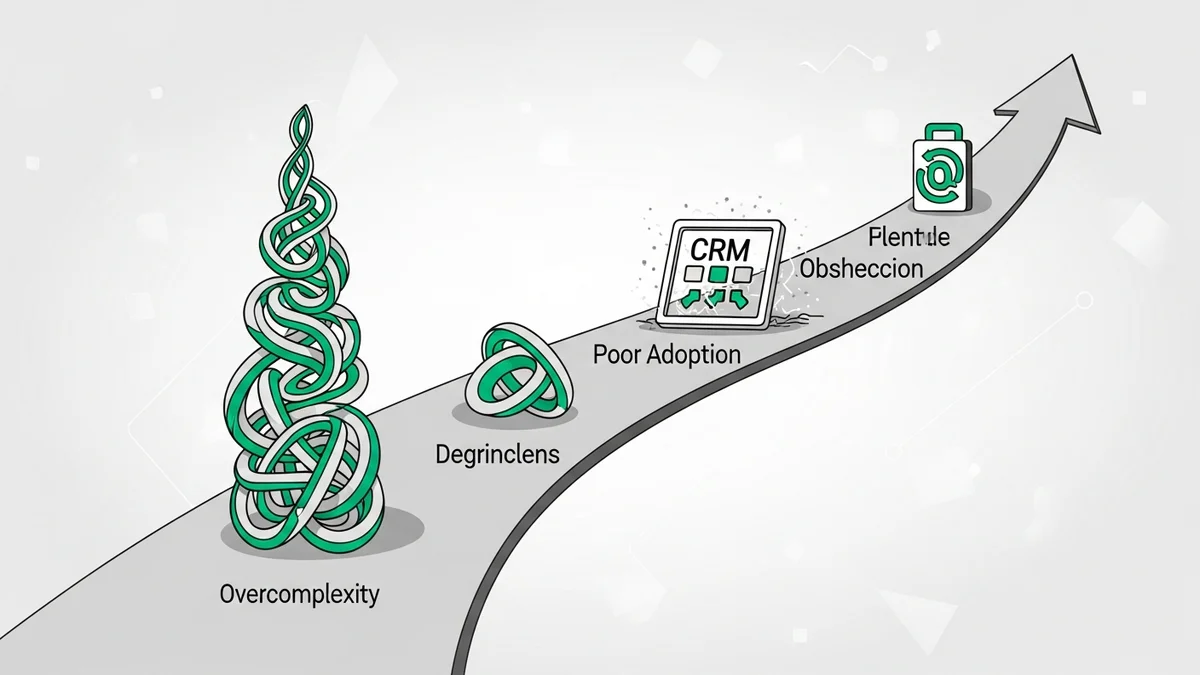
A CRM only delivers ROI when people actually use it. This sounds obvious, but adoption failure is the number one reason CRM investments underperform. Teams revert to spreadsheets, email threads, and tribal knowledge — and the CRM becomes an expensive contact list that no one trusts, updated only when a manager asks why deals aren't being logged.
Why Adoption Fails — and the Real Fix
The root causes are almost always the same: the CRM was selected by leadership without rep input, onboarding was treated as a one-time event rather than an ongoing program, and there are no enforcement mechanisms that make using the CRM easier than not using it. The solution is to make the CRM the path of least resistance. That means:
- Requiring all deal updates, call logs, and email threads to live inside the CRM — not in a separate tool that syncs imperfectly
- Running quarterly training refreshers, not just a two-hour onboarding session at launch
- Using pipeline dashboards as the default interface for team standups, making CRM data the common language of the sales team
Adoption by CRM Design
Some CRMs are simply better designed for adoption than others. Freshsales earns high adoption marks for its clean UI and built-in phone and email, which reduce the context-switching that kills consistent logging. Monday CRM works well in organizations where teams already use Monday.com for project management — the familiarity eliminates the learning curve that kills adoption elsewhere. Zoho CRM offers a free tier for up to three users, making it low-friction for very early-stage teams to build CRM habits before revenue demands a paid plan.
Mistake 5: Misconfiguring Automation — Or Ignoring It Entirely
Automation is the multiplier that separates startups that scale efficiently from those that hire their way into unprofitability. But automation done wrong is worse than no automation at all. Old workflows silently overwriting clean records, lead routing rules that haven't been updated since last year's ICP shift, and email sequences triggering at the wrong deal stage — these are the failure modes that compound into broken pipelines and missed forecasts.
The Two Failure Modes
The first is automation avoidance: teams intimidated by workflow configuration leave the feature entirely unused. Every rep operates slightly differently, manual errors accumulate, and pipeline forecasting becomes unreliable because there's no standardized process underneath it.
The second is automation neglect: workflows configured 12 months ago and never revisited. When your ICP changes, your pricing changes, or your team structure changes, every automation referencing old logic becomes a liability. This is one of the primary structural causes of CRM chaos identified in recent research — old automations overwriting good data is a system failure, not a people failure.
Building a Sustainable Automation Practice
Treat automation as a living system. Schedule a quarterly automation audit alongside your data audit. Document every active workflow, who owns it, and when it was last reviewed. Use your CRM's native automation — whether that's Salesforce Flow Builder, HubSpot workflows, or Close's sequence engine — not just to save time, but to enforce data standards automatically. Flag records with missing required fields rather than letting them degrade silently. The evidence supports this investment: well-implemented CRM automation helps teams resolve customer issues 29% faster, which compounds directly into retention rates and lifetime value.
Choosing the Right CRM for Your Startup Stage
Given the mistakes above, the right CRM is the one that minimizes your specific risk profile at your current stage. Early-stage startups need adoption-friendly interfaces and low configuration overhead. Growth-stage startups need automation depth, forecasting, and integration breadth. Here's how the major options compare:
| CRM | Best Startup Stage | Entry Price (seat/month, annual) | Core Strength | Primary Risk |
|---|---|---|---|---|
| HubSpot CRM | Seed → Series B | Free tier available; paid from $15 | All-in-one marketing + sales data unity | Cost escalates sharply at scale |
| Pipedrive | Pre-seed → Series A | $14 | Pipeline clarity, fast onboarding | Lighter on native marketing automation |
| Close | Seed → Series A (sales-heavy teams) | $49 | Built-in calling drives high adoption | Less suited for complex multi-stakeholder cycles |
| Salesforce | Series B+ | $25 (Starter Suite) | Deepest customization and ecosystem | Significant implementation overhead for small teams |
| Attio | Seed → Series A (B2B SaaS, PLG) | $34 | Flexible data modeling, product signal ready | Smaller third-party integration library |
| Salesflare | Pre-seed → Seed | $29 | Auto-enrichment eliminates manual data entry | Less suited for large enterprise scale |
Fix the System, Not the Symptoms
Every CRM mistake in this guide shares a common thread: they are structural failures disguised as behavior problems. Blaming reps for not logging calls misses the point if the CRM makes logging harder than sending a Slack message. Blaming marketing for bad data misses the point if there's no suppression logic on list imports. Blaming leadership for poor forecasting misses the point if the underlying pipeline data hasn't been validated in months.
Startup growth in 2026 depends on repeatable systems, not heroics. A CRM that is correctly chosen, actively maintained, and deeply embedded in your GTM motion is one of the highest-leverage investments a founder can make. A CRM that is poorly configured, poorly adopted, and filled with rotting data is a revenue drain dressed up as a productivity tool — and the 37% of teams losing deals to data quality failures are proof that the cost of inaction is real and measurable.
The startups that compound growth quarter over quarter are the ones that treat clean data, high adoption, and live automation as non-negotiable design requirements — not wishlist items to address after the next funding round. Start there, and your CRM becomes what it was always supposed to be: an unfair advantage.