
Why CRM Pricing Is More Complicated Than It Looks in 2026
The sticker price on a CRM is almost never what you actually pay. That gap between advertised pricing and real-world cost has always existed, but in 2026 it has widened significantly — driven by AI feature add-ons, usage-based billing layers, and a wave of compliance and integration fees that vendors bury in the fine print.
The global CRM market is expanding at a 14.2% CAGR through 2027, which means more vendors, more tiers, and more pricing complexity than ever before. For startups operating with constrained budgets, making the wrong pricing decision early can mean paying 20–40% more than necessary, or getting locked into a plan that forces an expensive upgrade six months in.
This guide cuts through the noise. We break down every major CRM pricing model, show you real numbers for the leading platforms, and give you a framework for calculating total cost of ownership — not just the monthly seat fee.
The 5 CRM Pricing Models That Define the Market
Understanding how vendors structure pricing is the first step to avoiding an expensive mistake. The model a vendor uses directly shapes how your costs scale as your team grows.
Per-User Pricing
The most common model: you pay a fixed monthly fee for each team member with an active account. It's predictable at small team sizes but compounds quickly. A 10-person sales team at $50/user/month is $6,000 per year before add-ons. The hidden complexity here is that "user" definitions vary — some platforms count view-only collaborators as full seats, others don't. Always clarify this before committing.
Flat-Fee Pricing
A single monthly price for unlimited users within a tier. Rare at the entry level but increasingly common among tools targeting small teams. The advantage is budget predictability; the downside is that flat-fee plans typically impose hard limits on contacts, workflows, or storage that force upgrades anyway.
Tiered Pricing
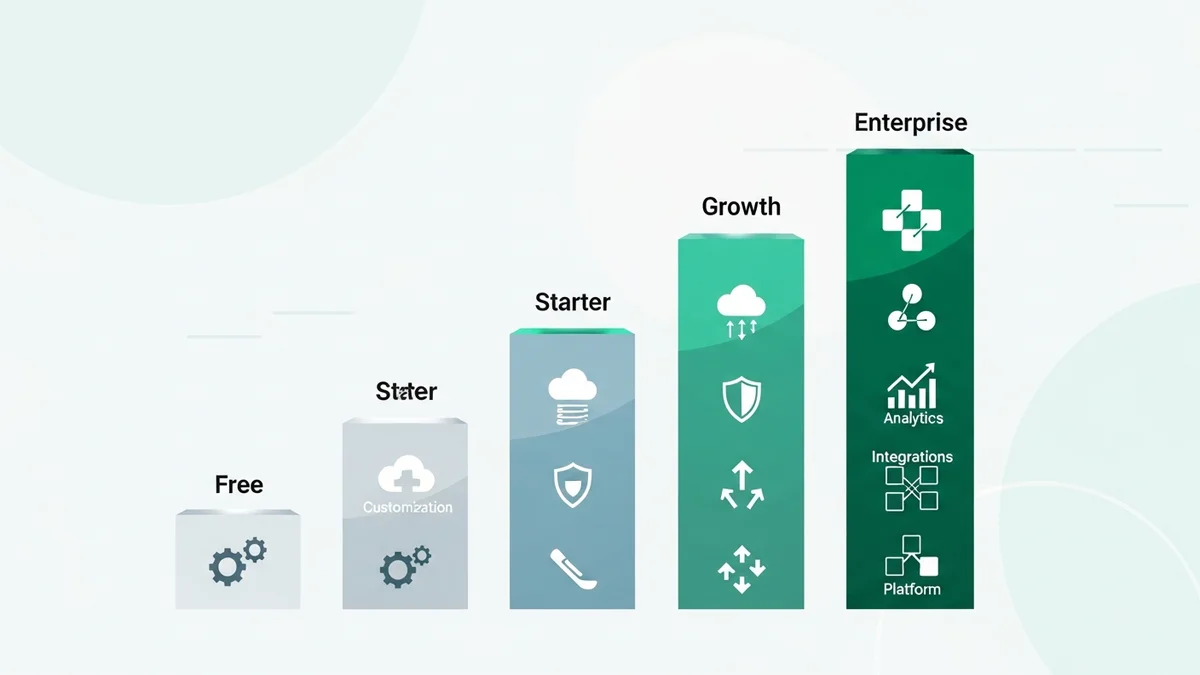
The dominant structure in 2026. Vendors offer three to five escalating plans — typically Starter, Professional, and Enterprise — each unlocking additional features. The trap for startups is that genuinely useful capabilities like email automation, custom fields, and pipeline forecasting often sit in mid-tier plans at 2–3x the entry price. You need to evaluate which tier actually covers your requirements, not just what the cheapest plan lists.
Freemium and Free Plans
Several major vendors offer permanently free tiers as acquisition tools. HubSpot CRM is the most prominent example. These plans are genuinely useful for very early-stage teams, but they are deliberately limited — once you need sequences, advanced reporting, or team-level permissions, you're looking at a significant jump to paid plans starting at €49/user/month.
Usage-Based and Modular Pricing
The fastest-growing model in 2026. Instead of a fixed seat fee, you pay for what you consume: API calls, AI credits, automation runs, or outbound email volume. This can be cost-effective for low-volume usage but wildly unpredictable for growing teams. Vendors including Salesforce now layer usage-based AI charges on top of per-seat fees, meaning your bill can spike without any deliberate plan upgrade.
What CRMs Actually Cost by Business Size
Pricing guidance is only useful when it's calibrated to your stage. Here's what the market looks like in 2026 across three common business profiles.
Early-Stage Startups and Freelancers: €10–€25/User/Month
At this tier, you're getting contact management, basic pipeline tracking, and limited automation. It's enough to replace spreadsheets and keep your team aligned on deals, but don't expect sophisticated reporting or deep integrations. Freshsales enters at €11/user/month, making it one of the most accessible options in this segment. Monday CRM sits in a similar range at €12–€24/user/month with a strong visual interface suited to teams already using Monday.com for project management.
The risk at this price point: essential features like email sequences or lead scoring almost always require moving to a higher tier, so map your actual workflow needs before assuming the cheapest plan will hold.
Growth-Stage Teams: €30–€90/User/Month
This is where most startups with a functioning sales motion land after 12–18 months. Plans in this range add workflow automation, custom fields, better analytics, and meaningful integration depth. Pipedrive operates across this band at €24–€99/user/month, and its Professional tier in the middle range is genuinely well-suited to SMB sales teams that need pipeline management without enterprise complexity. Zoho CRM covers €20–€65/user/month and offers exceptional feature density per euro — often underrated by startups chasing brand-name tools.
Newsletter
Get the latest SaaS reviews in your inbox
By subscribing, you agree to receive email updates. Unsubscribe any time. Privacy policy.
Scaling and Enterprise Teams: €90–€150/User/Month
At this level, you're paying for advanced AI features, custom object support, enterprise security and compliance controls, and dedicated support. Salesforce spans €25–€100/user/month on its core Sales Cloud, but the real-world cost at enterprise scale — with required add-ons, sandboxes, and AI licensing — typically lands well above that ceiling. For most startups, enterprise CRM pricing is a trap: you're paying for infrastructure complexity your team isn't ready to utilize.
2026 CRM Pricing Comparison: What the Leading Platforms Charge
The table below uses published pricing data from a February 2026 multi-platform comparison. Prices are per user per month and shown in EUR as sourced from the comparison study. All platforms listed offer a free trial period.
| CRM Platform | Price Range (Per User/Month) | Free Trial | Best Suited For |
|---|---|---|---|
| HubSpot CRM | €49 – €75 (free basic plan available) | Free plan + paid trial | Startups to mid-market teams |
| Salesforce | €25 – €100 | 30 days | Mid-market to enterprise |
| Zoho CRM | €20 – €65 | 15 days | Small and growing businesses |
| Pipedrive | €24 – €99 | 14 days | Small to medium sales teams |
| Monday CRM | €12 – €24 | 14 days | Small and medium teams |
| Freshsales | €11 – €71 | 21 days | Small to medium businesses |
| ActiveCampaign | Contact-volume based tiers | 14 days | Marketing-led sales teams |
| Salesflare | Flat-fee structure | 30 days | B2B startups and small teams |
The spread in this table tells an important story. At the low end, Freshsales and Monday CRM both enter below €15/user/month — genuinely competitive for a startup with a small team. HubSpot's paid tiers jump sharply from its free offering; the leap from free to €49/user/month is one of the steepest in the market, which is worth factoring into your growth planning even if you start on the free plan today.
Hidden Costs That Blow CRM Budgets
The advertised per-seat price is only one component of what you'll actually pay. Research consistently shows that hidden fees inflate real CRM costs by 20–40% above the base subscription. Here are the categories that catch startups off guard most often.
AI Feature Add-Ons
In 2026, basic AI is bundled into mid-tier plans from major vendors, but advanced capabilities — generative AI content creation, predictive sales forecasting, autonomous workflow agents, real-time sentiment analysis — are charged separately. Salesforce, Microsoft Dynamics, and HubSpot all follow this pattern. If your team intends to use AI-powered features substantively, get explicit per-seat or per-credit pricing for those modules before signing anything.
Integration and API Costs
Connecting your CRM to your email platform, calendar, billing system, or marketing stack often triggers additional fees — either through native integration paywalls or through third-party middleware like Zapier. API usage costs remain separately billed in 2026 across most enterprise-grade platforms. A startup running five integrations can see this line item add €15–€30/user/month on top of base pricing.
Onboarding and Implementation Fees
Many vendors charge mandatory onboarding fees for higher tiers, particularly at enterprise level. These can range from a few hundred euros for self-serve assisted setup to tens of thousands for full-service enterprise implementations. For Salesforce specifically, implementation costs from partner consultants frequently exceed the first year of software licensing.
Contact Volume and Data Limits
CRMs that price on contact volume rather than seats — or that impose contact caps on lower tiers — create a specific trap for startups with large prospect lists. If your contact list grows faster than your revenue, you can find yourself forced to upgrade well before you're ready. Always check contact limits on the specific tier you're evaluating, not just the headline feature list.
Compliance and Audit Features
Due to tightening data and AI regulations in 2026, features like audit trails, explainable AI logs, and compliance dashboards increasingly require premium tier access or separate add-on licensing. For startups in regulated industries — fintech, healthtech, legaltech — these are not optional costs.
How to Calculate True CRM Cost of Ownership
Before signing up for any CRM, run this calculation for the first 12 months:
- Base subscription: Per-seat price × number of users × 12 months
- Add-ons needed: AI credits, advanced analytics, additional storage, or compliance modules
- Integration costs: Native integration tiers or middleware subscriptions
- Onboarding and setup: One-time fees from vendor or third-party implementer
- Projected upgrade cost: Estimate when you'll outgrow your starting tier and price the next tier up
The sum of these five components is your real cost of ownership. In most cases, it will be 25–40% higher than the number you saw on the pricing page.
Our Recommendation: Match Pricing Model to Growth Stage
The right CRM pricing isn't about finding the cheapest option — it's about matching the pricing structure to where your startup actually is and where it's going in the next 18 months.
If you're pre-revenue or in early customer discovery, start with a freemium tool like HubSpot CRM's free tier or a low-cost entry plan. The goal is velocity of learning, not feature completeness. Don't pay for pipeline automation you haven't designed yet.
If you have a defined sales motion with a team of five or more, move to a paid tier that includes automation and real reporting. Pipedrive and Zoho CRM both offer strong mid-market value without the implementation complexity of enterprise platforms. Both support growth without requiring a six-figure CRM consultant engagement to get running.
If you're scaling fast and AI-led features are part of your sales strategy, get explicit written pricing for every AI module you intend to use before you sign. Per-agent and per-credit pricing structures are still maturing in 2026, and early contracts can lock you into unfavorable terms as usage scales.
Finally: always negotiate. CRM vendors — even at the SMB tier — routinely offer 15–30% discounts for annual commitments, multi-year deals, or startups in accelerator programs. The published price is rarely the final price if you ask.