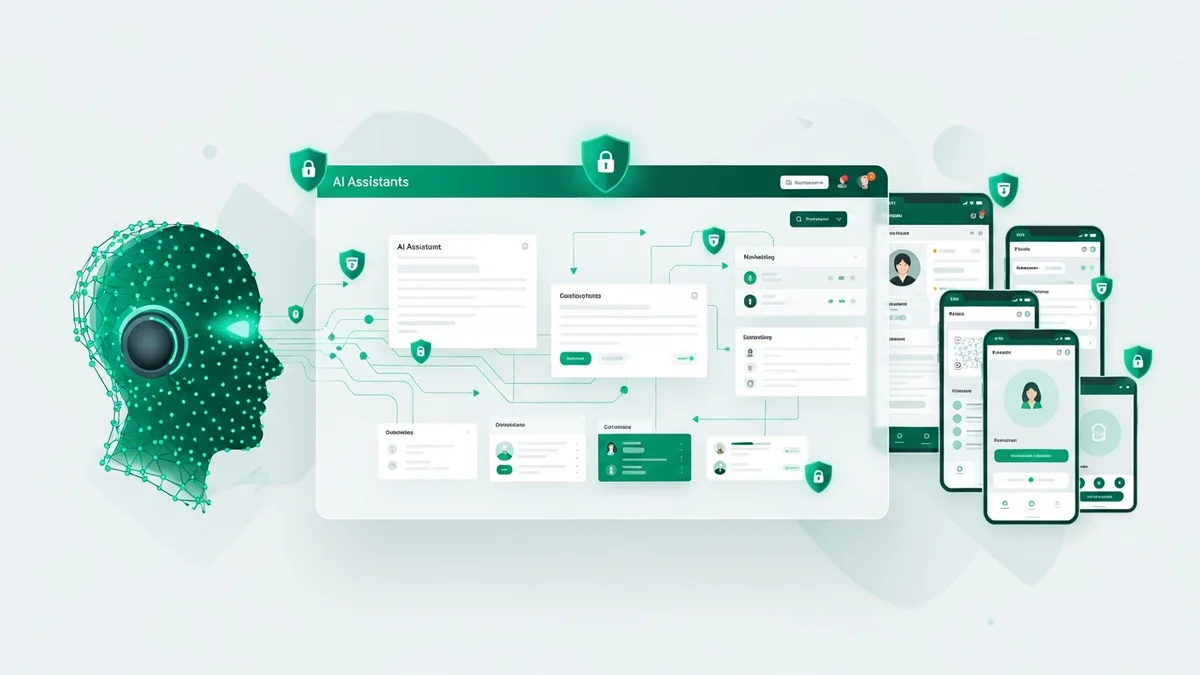

The CRM Landscape in 2026: From Assistant to Decision-Maker
If you built your startup's CRM stack in 2024 or even 2025, it's worth asking a blunt question: is the tool you're using still keeping up? The CRM market has crossed a genuine inflection point. According to Fortune Business Insights, the global CRM market is worth billions and accelerating, but the more significant shift isn't about market size — it's about what CRM software is now expected to do.
Last year's conversation was about AI-assisted selling: predictive lead scoring, smarter email personalization, better pipeline forecasting. In 2026, that conversation has moved. The question is no longer "how can AI help my team?" but "what can AI handle without my team?" For founders running lean operations, that distinction matters enormously.
This guide breaks down the CRM trends that will actually affect how startups sell, retain customers, and scale revenue in 2026 — not the vendor marketing noise, but the structural shifts that are reshaping which tools deserve a place in your stack.
Trend 1: Agentic AI Transforms CRM From Passive Tool to Active Operator
The single biggest development in CRM for 2026 is the rise of agentic AI — systems that don't wait for instructions. Where last year's AI features acted as sophisticated autocomplete (suggesting the next email, flagging a deal at risk), agentic AI takes action independently based on context, intent, and learned behavior.
Gartner has put a number on this: by the end of 2026, 40% of enterprise applications will feature task-specific AI agents, up from less than 5% in 2025. That's not incremental improvement — that's the entire category repositioning in a single year.
What Agentic AI Actually Does Inside a CRM
The practical examples are more useful than the hype. Agentic AI in a CRM context means:
- A contact sends an email mentioning a new office opening — your CRM updates the account record automatically, no rep required
- A deal goes cold based on engagement signals — the CRM schedules a re-engagement sequence and adjusts pipeline weighting without being asked
- Campaign performance drops below a threshold — messaging, timing, and audience segments are adjusted in real time
- Calendar priority reshuffles automatically based on deal stage and contact activity
Salesforce's Agentforce platform, a direct bet on this trend, had already signed over 18,500 deals by early 2026. That's not a pilot program — that's mainstream adoption moving faster than most startups have updated their own playbooks.
For startups, this matters differently than it does for enterprises. A 10-person sales team using a CRM with genuine agentic capabilities isn't just saving admin time — they're effectively adding headcount that doesn't burn equity. HubSpot CRM has been rolling out AI agent features across its Starter and Professional tiers, making this accessible below the enterprise price point. Salesforce is the headline player here, but the technology is filtering down fast.
Trend 2: CRM Consolidation — The End of Tool Sprawl
2025 exposed a problem that many startup founders already knew anecdotally: too many point solutions create more noise than signal. Teams were running separate tools for email outreach, deal tracking, customer success, analytics, and pipeline forecasting — and none of them talked to each other cleanly.
2026 is the year of consolidation. According to Sirocco's analysis of enterprise adoption patterns, the most successful revenue organizations in 2025 reduced tool sprawl, improved data visibility, and made processes measurable. That discipline is now the baseline expectation, not a competitive advantage.
What This Means for Startup CRM Choices
The practical implication is that picking a CRM in 2026 means evaluating it as a platform, not a point tool. A CRM that handles contact management but requires four integrations to get usable sales data is a liability, not an asset. The hidden costs — maintenance, sync failures, data inconsistency — kill productivity in ways that don't show up on a pricing page.
Pipedrive has historically been praised for its clean pipeline UI, but startups scaling past Series A often find themselves bolting on additional tools. ActiveCampaign sits at a useful intersection of CRM and marketing automation for teams that want those functions unified. The consolidation trend rewards tools that cover more ground natively.
Newsletter
Get the latest SaaS reviews in your inbox
By subscribing, you agree to receive email updates. Unsubscribe any time. Privacy policy.
Trend 3: Predictive Becomes Proactive — Data Integration as Infrastructure
Predictive analytics — knowing which deals are likely to close, which customers are at churn risk — was the headline feature of 2024 CRM pitches. In 2026, prediction alone isn't sufficient. The trend is toward proactive CRM: systems that don't just surface an insight but take the next step.
This requires data integration that most startups haven't prioritized. CRM is only as intelligent as the data flowing into it. If your customer data lives in your product analytics platform, your support tool, and your billing system — but your CRM only sees email interactions — no amount of AI will produce accurate proactive recommendations.
The Integration Imperative
Data integration has become non-negotiable for teams that want CRM to function as the operational backbone of revenue — connecting sales, marketing, customer success, and analytics in real time. This isn't a 2027 consideration; the organizations building this infrastructure now are already operating with a meaningful advantage.
Attio has built its architecture around this problem specifically — treating data enrichment and integration as first-class features rather than afterthoughts. For startups with a product-led motion, where customer behavior data is critical for sales context, this approach is increasingly compelling. Salesflare similarly auto-populates contact and company data from email, calendar, and LinkedIn, reducing the manual input that degrades data quality over time.
Trend 4: CRM as Revenue Operating System
The framing of CRM as a "sales tool" is becoming outdated. In 2026, the CRM is being repositioned as the revenue operating system — the central coordination layer for every team that touches revenue: sales, marketing, customer success, and increasingly, product.
This isn't just a semantic shift. It changes which features matter, which integrations are critical, and how CRM adoption should be measured. A revenue OS is judged not on how well it tracks deals, but on how intelligently it connects information and guides action across the entire customer lifecycle.
Startup-Specific Implications
For early-stage startups, this trend has a counterintuitive implication: start with a CRM that can scale into this role, even if you don't need all the functionality yet. Migrating CRM platforms mid-growth is expensive and disruptive. Choosing a tool that covers sales pipeline now but can expand into customer success workflows and marketing attribution later is a better bet than optimizing purely for today's requirements.
Zoho CRM offers a broad platform that spans sales, marketing, and service functions within a single ecosystem — relevant for startups that want to avoid the integration tax later. Monday CRM has positioned itself as a work management layer that extends naturally into revenue operations, which suits founders who already use it for project coordination.
CRM Feature Comparison: 2026 Trends Readiness for Startups
Not every CRM has invested equally in the capabilities that define 2026. The table below maps key platforms against the four major trend areas, based on publicly available feature sets and announced roadmaps as of early 2026.
| CRM Platform | Agentic AI Features | Native Integration Depth | Proactive Automation | Starting Price (per user/mo) | Best For |
|---|---|---|---|---|---|
| Salesforce | Advanced (Agentforce, 18,500+ deals closed) | Very High | Yes — Einstein AI | $25 | Scaling startups, Series B+ |
| HubSpot CRM | Growing (Breeze AI agents) | High | Yes — workflows + AI | $15 | Seed to Series A, inbound-led |
| Attio | Emerging | High (data-first architecture) | Partial | $29 | PLG startups, technical founders |
| Pipedrive | Basic (AI Sales Assistant) | Medium | Partial | $14 | Outbound-focused small teams |
| Zoho CRM | Moderate (Zia AI) | High (native Zoho ecosystem) | Yes | $14 | Budget-conscious, broad platform needs |
| Freshsales | Moderate (Freddy AI) | Medium-High | Yes | $9 | Early-stage, simple pipeline management |
| Close | Basic | Medium | Partial | $19 | Inside sales teams, high-volume calling |
What Startups Should Actually Do in 2026
Trend awareness without an action framework is just noise. Here's a practical read on how early-stage companies should respond to what's happening in CRM this year.
If You're Pre-Product-Market Fit
Don't over-engineer your CRM stack. The consolidation trend is real, but it applies to organizations with defined revenue processes. Before PMF, your priority is speed and flexibility. Pick something lightweight — Salesflare auto-populates contact data with minimal configuration, which means your team is actually logging activity instead of skipping it. Agentic AI is genuinely impressive, but it needs clean historical data to work well. Build the data habits first.
If You're Scaling a Sales Team
This is where the agentic AI and data integration trends bite hardest. A growing sales team creates data entry debt faster than managers realize, and the cost compounds — bad data produces bad predictions, which produces bad decisions at the exact moment you're trying to scale. Evaluate your CRM not just on its current feature set but on its AI roadmap and integration architecture. A tool that was excellent in 2023 may be a drag by late 2026 if it hasn't invested in autonomous data handling.
If You're Approaching Series B
The revenue operating system framing becomes critical at this stage. You likely have a marketing function, a customer success team, and a sales team that need to operate from a shared view of the customer. Evaluate whether your current CRM can serve all three, or whether you're heading into a multi-tool fragmentation problem. Switching costs only increase with team size, so making this assessment now — rather than when you're at 50 people — is the right call.
The Honest Takeaway on CRM Trends in 2026
The through-line across every major CRM development in 2026 is this: the tools are getting smarter faster than most organizations are adapting to use them. Agentic AI is not a feature on a roadmap — it's already in production at scale, with Gartner projecting 40% enterprise app penetration by year-end. Data integration is not an IT project — it's the prerequisite for everything else working.
For startups, the opportunity is significant. You don't have a legacy CRM implementation to migrate, a 200-person sales org with ingrained habits, or a 5-year contract locking you to a platform that's fallen behind. You can choose the right tool for where the market is going, not where it was. That's a genuine competitive advantage — but only if you use it.
The worst outcome is choosing a CRM based on a 2023 evaluation, layering on point solutions to compensate for its gaps, and arriving at 2027 with a fragmented, expensive stack that can't support the autonomous workflows your competitors are running today. The research is clear on what's coming. The question is whether your tooling decisions reflect it.