
The Honest Answer Most Comparison Posts Won't Give You
Here's the uncomfortable truth about the Salesforce vs. HubSpot debate for startups: both platforms are probably overkill for you — at least in your first two years. That said, choosing the wrong one at the wrong stage can cost you tens of thousands of dollars in wasted seats, failed implementations, and forced migrations. So the question is worth answering carefully.
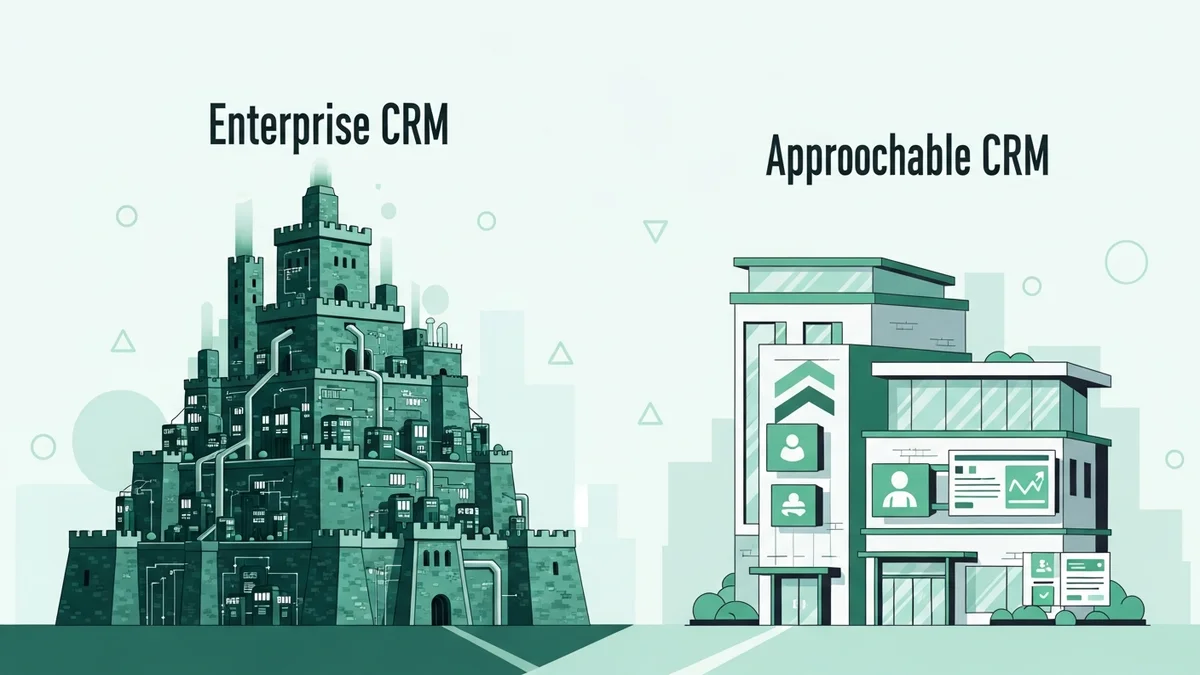
HubSpot CRM is built for marketing-driven organizations and scales well up to around 500 employees. Salesforce is an enterprise platform with roughly 38% of the global CRM market, designed for organizations with complex workflows, compliance requirements, and dedicated admin headcount. Startups sit awkwardly between these two targets — and that's exactly why this comparison matters.
Pricing: What You'll Actually Pay
Pricing is where the two platforms diverge most sharply in practice. HubSpot leads with a free CRM tier that's genuinely useful — not a crippled trial — which is a real advantage for pre-revenue and seed-stage teams.
| Tier | HubSpot (Sales Hub) | Salesforce |
|---|---|---|
| Free | $0 — contacts, deals, basic pipeline | Not available |
| Entry paid | Starter: $15/seat/month (annual) | Starter Suite: $25/user/month (annual) |
| Mid-tier | Professional: $90/seat/month | Pro Suite: $100/user/month |
| Enterprise | Enterprise: $150/seat/month | Enterprise: $165/user/month |
| Unlimited / Top tier | Not applicable | Unlimited: $330/user/month |
On paper, the per-seat numbers look comparable at the mid-market tier. In practice, the total cost of ownership for Salesforce runs significantly higher. Why? Because Salesforce almost always requires a dedicated administrator or a consulting partner for implementation — costs that HubSpot's self-serve model largely avoids. For a 10-person startup, the difference between a $15/month HubSpot Starter seat and the real all-in cost of a Salesforce deployment (licensing + admin + consulting) can easily be $30,000–$80,000 in year one.
HubSpot's free tier is a genuine on-ramp. You can run pipeline management, contact records, email logging, and basic deal tracking at zero cost. This matters enormously for pre-Series A teams managing burn rate.
Ease of Use and Time to Value
This is where the gap is widest, and it's not close. HubSpot is designed to be deployed quickly by non-technical users. A competent sales ops person or even a founder can have a functioning HubSpot CRM running in a week. Custom fields, pipelines, email sequences, and basic reporting are all accessible without writing a line of code.
Salesforce is architecturally built for depth and customization — its Lightning Platform can model virtually any business process. That power comes with complexity. A default Salesforce org out of the box is not a finished product. It requires configuration, data modeling decisions, workflow setup, and training. Most startups that attempt a DIY Salesforce implementation end up with a broken system that nobody uses, which is worse than having no CRM at all.
Implementation Reality Check
Based on real-world implementation data, HubSpot's average time-to-adoption for small teams is measured in days to weeks. Salesforce implementations for companies under 50 people typically take 2–4 months with a partner — and that's when they go well. For a startup where velocity matters, this timeline difference is a strategic decision, not just a procurement one.
If you want to explore lighter-weight options that skip this complexity entirely, Pipedrive and Close are built specifically for sales-led teams that need to move fast without an ops hire.
Feature Comparison: What Startups Actually Need
Pipeline and Deal Management
Both platforms handle multi-stage deal pipelines, contact and company records, and activity logging. HubSpot's pipeline UI is cleaner and faster to navigate for small teams. Salesforce's Opportunity object is more powerful for complex enterprise sales cycles with multiple stakeholders, approval workflows, and revenue scheduling — features most startups won't touch for years.
Newsletter
Get the latest SaaS reviews in your inbox
By subscribing, you agree to receive email updates. Unsubscribe any time. Privacy policy.
Marketing and Sales Alignment
HubSpot's original product was marketing automation, and it shows. The integration between marketing campaigns, lead capture, contact nurturing, and sales pipeline is seamless in a way Salesforce has never fully replicated natively. If your startup's growth depends on inbound marketing and content — and most B2B SaaS companies do — HubSpot's unified approach is a genuine advantage. Salesforce's marketing capability (Marketing Cloud, Pardot/Account Engagement) is powerful but requires a separate product and separate licensing.
Reporting and Analytics
Salesforce's reporting engine is more powerful at scale. Custom report types, cross-object reporting, and its Einstein Analytics layer offer capabilities HubSpot can't match at the enterprise level. For most startups, however, HubSpot's built-in dashboards cover 90% of what a sales leader actually needs to review in a weekly pipeline meeting. Over-built reporting infrastructure is a classic startup mistake — you want signal, not complexity.
Integrations
Salesforce's AppExchange has thousands of integrations built over 25 years. HubSpot's ecosystem has grown substantially and covers most tools in the modern startup stack: Slack, Zoom, LinkedIn, Google Workspace, Stripe, and more. For most early-stage teams, the practical integration coverage is equivalent.
| Feature | HubSpot | Salesforce | Startup Relevance |
|---|---|---|---|
| Free tier | Yes | No | High — critical for pre-revenue teams |
| Setup time | Days to weeks | Months | High — speed matters at early stage |
| Marketing automation | Native, unified | Separate product/license | Medium — depends on growth model |
| Custom workflows | Professional tier+ | All tiers (with config) | Low at seed, high at Series B+ |
| AI features (2026) | Breeze AI | Agentforce | Medium — both are maturing |
| Compliance (HIPAA, SOX) | Limited | Extensive | High if regulated industry |
| Admin required | No (Starter/Pro) | Yes (almost always) | High — headcount cost is real |
AI in 2026: Agentforce vs. Breeze
Both platforms have made AI a centerpiece of their 2025–2026 roadmaps. Salesforce launched Agentforce, a suite of autonomous AI agents that can handle tasks across the sales and service workflow — qualifying leads, summarizing opportunities, drafting follow-ups, and routing cases. It's impressive technology, but it lives at the Enterprise and Unlimited tier where it's most capable, putting it well out of range for most startups on cost alone.
HubSpot's Breeze AI is embedded throughout the platform: AI-assisted email writing, deal scoring, conversation intelligence, and content generation. Breeze is more accessible at lower price tiers and more immediately useful for the day-to-day tasks a small sales team actually performs. For a startup evaluating AI utility today, HubSpot's implementation is more practical and less dependent on architectural complexity to deliver value.
Neither AI suite is mature enough yet to be the deciding factor in a CRM purchase. Treat them as a bonus, not a reason to choose either platform.
When Salesforce Is the Right Choice for a Startup
There are scenarios where Salesforce makes sense at the startup stage, and they're more specific than most people think:
- Regulated industries: If you're building in healthcare, financial services, or insurance and need HIPAA, SOX, or FINRA compliance baked into your CRM from day one, Salesforce's industry-specific clouds (Health Cloud, Financial Services Cloud) have no real competitor. HubSpot's compliance posture is improving but isn't there yet for regulated enterprise customers.
- Enterprise-focused sales: If your ACV is above $50,000 and your buyers are Fortune 500 procurement teams, your CRM needs to match the complexity of enterprise sales cycles. Salesforce's account hierarchy, opportunity management, and forecasting tools are purpose-built for this.
- You already have an admin or budget for one: If your team includes a dedicated revenue ops or Salesforce admin from day one, the calculus changes. The platform's power becomes accessible.
- Your Series A investor mandates it: Some growth-stage investors have strong opinions about CRM stack. If Salesforce is the expectation in your investor reporting ecosystem, aligning early avoids a painful migration later.
When HubSpot Is the Right Choice for a Startup
HubSpot wins for most startups, most of the time — but for specific reasons, not just because it's cheaper:
- Inbound-led growth: If your pipeline depends on content marketing, SEO, or paid acquisition feeding into a nurture sequence, HubSpot's unified platform from traffic to closed deal is unmatched at this price point.
- Small sales teams (under 20 reps): The friction of Salesforce's complexity actively hurts adoption at this scale. A CRM nobody uses is worse than no CRM.
- Founder-led sales transitioning to a sales team: HubSpot scales from free (founder doing everything) to a structured sales team (Professional) without requiring a platform migration. That continuity has real value.
- You need to move fast: If you're iterating on your go-to-market every 90 days, you cannot afford a CRM that takes 90 days to configure.
The Alternatives Neither Company Wants You to Consider
The honest reality — backed by practitioners who implement both platforms — is that the majority of startups don't need either HubSpot or Salesforce in their first two years. Both platforms are designed for companies with established go-to-market motions and dedicated revenue operations support.
If you're pre-Series A or have a sales team under 10 people, you're likely better served by a purpose-built sales CRM. Pipedrive is designed specifically for sales teams that need clean pipeline management without the overhead. Close is the top choice for high-volume inside sales teams with built-in calling and sequencing. Attio is the modern pick for founder-led sales teams that want a flexible, data-rich CRM without the enterprise bloat.
If you're evaluating on a budget, Zoho CRM offers a surprisingly capable feature set at a fraction of the cost of either platform and is worth a serious look before committing to either HubSpot or Salesforce contracts.
The best CRM is the one your team actually uses. That's a cultural and operational question as much as a software one.
The Verdict: Salesforce vs. HubSpot for Startups
For most startups, HubSpot is the safer, smarter default. The free tier removes financial risk, the self-serve implementation removes operational risk, and the marketing-sales alignment removes one of the most common growth-stage coordination problems. You can start free, upgrade to Starter at $15/seat/month when you need email sequences, and scale to Professional at $90/seat/month when your pipeline demands it. The total cost at each stage is predictable and proportionate to where you actually are.
Salesforce is not the wrong answer — it's the right answer for the wrong stage. It earns its market dominance with enterprises, regulated industries, and complex sales organizations. For a 12-person startup trying to close its first 100 customers, it introduces cost, complexity, and risk that have nothing to do with your actual problems.
Choose HubSpot if you're moving fast and want marketing and sales unified. Choose Salesforce if you're in a regulated industry or your buyers expect enterprise-grade infrastructure. Choose something simpler than both if you're still figuring out your go-to-market. That's not a hedge — that's the honest strategic call.