
The Real Difference Between HubSpot and Pipedrive for Startups
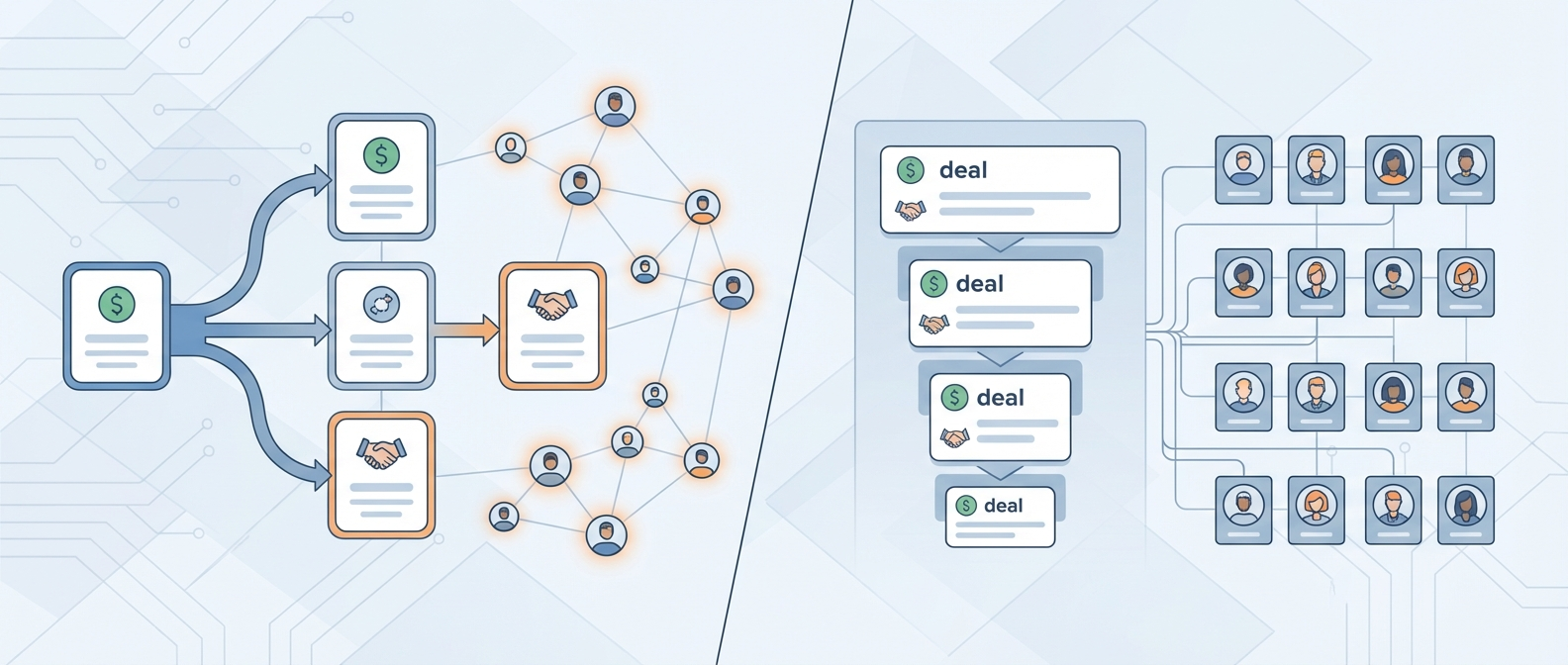
Most CRM comparisons are really just feature-list recitations dressed up as analysis. This one isn't. If you're a startup choosing between HubSpot CRM and Pipedrive in 2026, the decision comes down to one honest question: are you primarily solving a sales execution problem, or a go-to-market alignment problem?
HubSpot wants to be your entire growth engine — marketing, sales, service, and content management unified under one roof, serving over 228,000 customers worldwide. Pipedrive is narrower and prouder of it: a sales-first platform laser-focused on pipeline visibility and deal velocity. Neither is universally better. But for most startups, one is clearly the wrong choice.
This guide will tell you which.
HubSpot vs Pipedrive: Head-to-Head Comparison
Before diving into analysis, here's how the two platforms stack up across the criteria that matter most to early-stage and growth-stage startups:
| Criteria | Pipedrive | HubSpot CRM |
|---|---|---|
| Free plan | 14-day trial only | Free forever (feature-limited, unlimited contacts) |
| Pricing model | Clear per-user pricing; add-ons billed separately | Free tier available; scaling features and contacts can get expensive |
| Sales pipeline visibility | Best-in-class visual boards, drag-and-drop | Clean pipelines integrated with marketing and service |
| Built-in marketing tools | Limited — requires Campaigns add-on or Outfunnel | Full suite: forms, landing pages, email, ads |
| Email marketing & automation | Included on higher tiers only | Native, advanced workflows included |
| Workflow automation | Rules-based, up to 180 workflows | AI-driven, customizable sequences and triggers |
| AI features | Sales Assistant, nudges, reminders | Breeze AI agents, predictive lead scoring, content automation |
| Reporting & dashboards | Accessible across all plans | Advanced reporting on higher tiers |
| Integration ecosystem | 400+ apps, strong with Zapier and Outfunnel | 1,000+ native apps + HubSpot Marketplace |
| Ease of setup | Up and running in a day; no setup fees | Free CRM available instantly; advanced plans may require onboarding fees |
| Scalability | SMB-focused, great for lean teams | Enterprise-ready with custom objects, roles, and permissions |
| User experience | Sales-first, minimal clutter | Modern and intuitive, but broader scope means more menus |
Sales Pipeline and User Experience: Where Pipedrive Wins Outright
If your startup's primary pain point is deals getting stuck, reps losing track of follow-ups, and management having no clear view of pipeline health — Pipedrive was built for exactly that problem. Its visual pipeline boards with drag-and-drop deal management are genuinely best-in-class. The interface is sales-first by design, which means reps spend less time navigating and more time selling.
HubSpot's Sales Hub is competitive here, and the pipeline functionality is solid, but the broader platform introduces menus, tabs, and feature density that simply doesn't exist in Pipedrive. For a 5-person startup sales team, that cognitive overhead compounds fast. You'll find reps defaulting to spreadsheets not because HubSpot is bad, but because it's more than they need.
Pipedrive's Sales Assistant and AI Nudges
Pipedrive's AI layer is focused where the platform itself is focused: on sales. The Sales Assistant surfaces deal nudges, follow-up reminders, and stale pipeline alerts. It's not trying to predict content performance or score inbound blog traffic — it's keeping reps honest about their pipeline. For a startup with a small, scrappy sales team that doesn't have a RevOps function, this kind of lightweight AI guardrail is often more useful than a sophisticated feature set nobody uses.
HubSpot's Breeze AI: Powerful If You Use All the Hubs
Newsletter
Get the latest SaaS reviews in your inbox
By subscribing, you agree to receive email updates. Unsubscribe any time. Privacy policy.
HubSpot's Breeze AI agents go significantly deeper: predictive lead scoring, content automation, and workflow triggers across the full platform. But the value compounds only when you're running marketing, sales, and service together through HubSpot. If you're using Sales Hub in isolation, Breeze is underutilized. This is an important nuance — HubSpot's AI advantages are real, but they're architecture-dependent.
Marketing and Automation: The Dividing Line
This is where the comparison becomes a genuine fork in the road for startups.
Pipedrive requires a Campaigns add-on or a third-party integration like Outfunnel to run email marketing. Its native automation is rules-based and capped at 180 workflows on standard plans. For a startup that already uses a dedicated email platform like ActiveCampaign for marketing, this isn't a dealbreaker — you connect the tools and move on. But if you want a single platform managing both marketing automation and CRM without stitching together a stack, Pipedrive will frustrate you.
HubSpot's Marketing Hub includes email campaign builders with visual workflows, landing page creation with A/B testing, social media management, SEO tools, and complete campaign attribution from marketing touchpoint to closed-won deal. On Professional and Enterprise tiers, you get adaptive testing, complex branching automation logic, and machine-learning-powered lead scoring. This is not a light feature set — it's a full marketing platform, and it's why HubSpot's pricing scales the way it does as you grow.
The Hidden Cost of HubSpot's Contact-Based Pricing
HubSpot's free CRM is genuinely free and includes unlimited contacts — and for early-stage startups, this is an underrated advantage. You can manage your entire contact database, run basic pipelines, and start building processes before spending a dollar. The challenge is that as you activate more marketing features and grow your contact list, costs scale on both dimensions simultaneously. HubSpot's free tier is a generous on-ramp, but the jump from free to Professional is a meaningful budget commitment for a seed-stage company.
Integrations: 1,000 vs 400 — Does the Number Matter?
HubSpot's ecosystem includes 1,000+ native integrations plus a growing marketplace. Pipedrive connects with 400+ apps, with particularly strong support for Zapier and Outfunnel. In raw numbers, HubSpot wins. In practical terms for most startups, it barely matters.
The integrations startups use most — Slack, Google Workspace, Stripe, Intercom, Zoom — are available on both platforms. The gap becomes relevant only when you have niche internal tooling or very specific workflow requirements. If you're evaluating alternatives beyond these two, it's worth also looking at how platforms like Attio and Salesflare handle integrations with a more modern API-first architecture — both are worth considering for technical founding teams.
Where HubSpot's integration breadth does matter is in the all-in-one context. When your marketing, CRM, and service data all live in one system, you eliminate an entire category of integration problems. If you're building a multi-tool stack and expecting Pipedrive to be one node in it, Pipedrive's Zapier support handles that well. If you want to minimize the number of systems your team logs into, HubSpot's native ecosystem becomes a real advantage.
Pricing and Startup Budget Reality
Pipedrive uses clear per-user pricing with add-ons billed separately, and it's consistently positioned as one of the more affordable dedicated sales CRMs. There is no free tier — only a 14-day trial — which means startups are making a paid commitment from day one. The transparency is a genuine strength: you know what you're paying, when you're paying it, and what you get for it.
HubSpot's pricing structure is the opposite: extraordinarily generous at the bottom (free forever, unlimited contacts, core CRM features) and increasingly expensive as you activate marketing, service, and operations functionality. For pre-revenue startups or teams with fewer than 10 contacts under active management, HubSpot Free is genuinely hard to beat. For growth-stage startups unlocking automation, reporting, and marketing workflows, the monthly cost can become a significant line item.
The honest framing: if you need a serious sales pipeline today and nothing else, Pipedrive will likely be cheaper. If you're planning to bring your marketing stack into the same system and run HubSpot end-to-end, the economics can swing the other way — especially compared to paying for a CRM plus separate marketing automation software. Startups that find HubSpot's pricing steep mid-growth sometimes look at alternatives like Zoho CRM or Freshsales, both of which offer broader feature sets at lower price points, though with trade-offs in polish and ecosystem depth.
Scalability: Which Platform Grows With You?
Pipedrive is SMB-focused by design, and it's excellent for lean teams. As you scale past 50 or 100 sales reps, the limitations become more visible: custom objects are limited, user permissions are less granular, and the platform lacks the enterprise-grade features that a large revenue organization needs. If you're a Series A startup planning to build a large sales org and a separate marketing function, Pipedrive may be a platform you graduate from rather than a platform you grow with.
HubSpot is explicitly enterprise-ready, with custom objects, granular role-based permissions, advanced forecasting, and conversation intelligence built for scaling organizations. The platform has grown alongside companies from 5 employees to 5,000. This architectural flexibility is reflected in the Enterprise tier pricing, but it means you're unlikely to outgrow HubSpot in the way you might outgrow Pipedrive. If you're planning aggressive growth, Salesforce is the only other platform with comparable enterprise depth — though the implementation complexity and cost are in a different category entirely.
Which CRM Should Startups Choose in 2026?
Choose Pipedrive if:
- Your primary bottleneck is sales pipeline visibility and deal execution, not marketing alignment
- You have fewer than 20 reps and want a system that stays out of their way
- You already use dedicated marketing tools and don't need CRM-native campaign features
- You value pricing transparency and predictable costs over an expansive feature footprint
- You want to be up and running in under a day without onboarding fees
Choose HubSpot if:
- You want marketing, sales, and service data in one system from the start
- You're pre-revenue or early-stage and need a capable free CRM to start building processes
- You plan to run inbound marketing and need attribution connecting campaigns to closed deals
- You're building for scale and don't want to migrate platforms as you grow
- AI-driven automation — predictive scoring, content automation, Breeze agents — is a priority
Neither Is a Safe Default
The biggest mistake startups make is defaulting to HubSpot because it's well-known, or defaulting to Pipedrive because it's simpler. The right choice depends entirely on where your friction actually lives. A product-led growth startup with a short sales cycle and heavy inbound motion should almost certainly be on HubSpot. A B2B SaaS company with a 60-day enterprise sales cycle and a separate marketing team already using another tool should seriously evaluate whether Pipedrive's focused simplicity outperforms HubSpot's feature density for their specific use case.
If you're still undecided, the free HubSpot CRM costs nothing to start. Pipedrive's 14-day trial is enough time to load your pipeline and see whether the interface clicks for your team. Run both, impose a real deadline on the decision, and trust what your reps actually use.
For startups evaluating the broader CRM landscape, it's also worth comparing lighter-weight modern options — Close is particularly strong for outbound-heavy teams, and Monday CRM suits teams that want project-management-style visibility alongside deal tracking. No single platform is right for every startup, but these two — HubSpot and Pipedrive — remain the most well-rounded options for most early-stage teams in 2026.