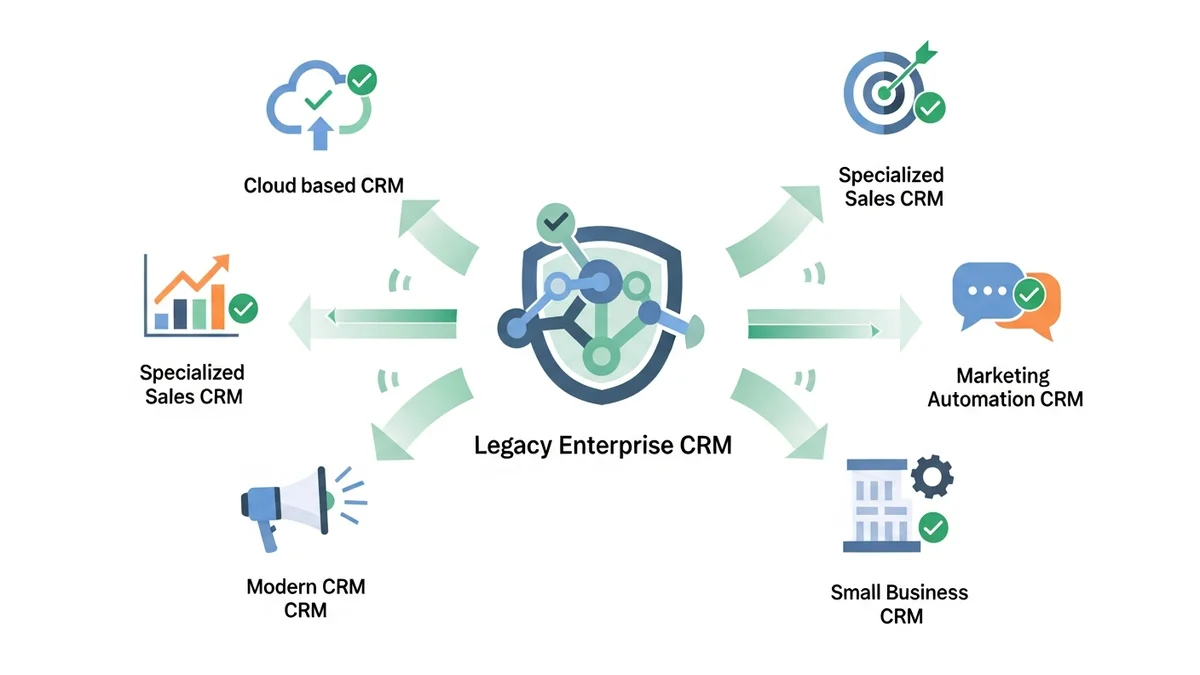
Why Look for Salesforce Alternatives?
Salesforce is the world's largest CRM platform for a reason — it can do almost anything. But that power comes with trade-offs that hit startups especially hard. Here are the most common reasons founders and sales leaders look for alternatives in 2026:
- Prohibitive cost at scale: Salesforce pricing starts at $25/user/month for the Starter plan, but most startups quickly discover they need features locked behind the Professional ($80/user/month) or Enterprise ($165/user/month) tiers. Add admin costs, integration fees, and AppExchange add-ons, and total cost of ownership can be 3-5x the sticker price.
- Implementation complexity: Getting Salesforce configured properly often requires a dedicated admin or consultant. For a 5-person startup, spending weeks on CRM setup is a luxury you cannot afford. Many teams report that customizing workflows feels overwhelming compared to simpler alternatives.
- User adoption struggles: Salesforce's depth is also its weakness for small teams. The interface has improved with Lightning, but it still presents a steep learning curve. When reps avoid the CRM or only use basic features, the investment is wasted.
- Overkill for early-stage needs: Territory management, CPQ, custom objects with complex relationships — these are powerful features, but a pre-Series A startup rarely needs them. You end up paying for enterprise machinery while running a lean sales motion.
- Data quality challenges: Reports indicate that over 30% of CRM data in Salesforce instances is outdated or duplicated. Without a dedicated ops person maintaining data hygiene, the platform's analytics become unreliable.
The good news: the CRM market in 2026 is mature and competitive. There are excellent alternatives at every price point that match or exceed Salesforce for startup use cases.
Top 10 Salesforce Alternatives in 2026
1. HubSpot CRM — Best Overall Salesforce Alternative
HubSpot CRM is the most popular Salesforce alternative for startups, and for good reason. The free tier includes unlimited users with contact management, deal pipelines, email tracking, meeting scheduling, and live chat. The Starter plan at $15/user/month unlocks automation, custom reporting, and deeper integrations.
Where HubSpot competes directly with Salesforce is in breadth: marketing, sales, service, and operations hubs all share the same database. But where HubSpot wins for startups is usability. A new rep can be productive on day one without admin training. The automation builder is visual and intuitive, the reporting is clean, and the ecosystem of free integrations is massive. For a full head-to-head breakdown, see our Salesforce vs HubSpot comparison.
Best for: Startups that want Salesforce-level breadth without the complexity and cost.
2. Pipedrive — Best for Visual Pipeline Management
Pipedrive is the anti-Salesforce: focused, visual, and built around an activity-based selling methodology. Plans start at $14/user/month with a 14-day free trial. The kanban-style pipeline board gives reps instant clarity on every deal's status.
What makes Pipedrive a compelling Salesforce replacement is its philosophy. Instead of trying to be everything, Pipedrive focuses on helping sales teams close deals. Smart contact data enrichment, revenue forecasting, workflow automations, and AI-powered sales assistant — all without requiring a Salesforce admin to configure. See how it compares in our HubSpot vs Pipedrive comparison.
Best for: Sales-driven startups that want an intuitive pipeline CRM their team will actually use.
3. Freshsales — Best AI-Powered Alternative at Scale
Freshsales competes directly with Salesforce on AI capabilities but at a fraction of the price. The free plan supports 3 users, and paid plans start at just $9/user/month. Freddy AI provides lead scoring, deal insights, sentiment analysis, and next-best-action recommendations — features that require Salesforce Einstein at enterprise pricing.
For startups graduating from spreadsheets or lightweight tools, Freshsales offers a credible growth path. The built-in phone, email, chat, and WhatsApp channels eliminate the need for separate communication tools. The Freshworks ecosystem (Freshdesk, Freshmarketer) provides expansion options as you scale.
Best for: Startups that want Salesforce-caliber AI features without enterprise pricing.
4. Zoho CRM — Best Ecosystem Alternative
Zoho CRM is the closest thing to a Salesforce ecosystem at SMB prices. Free for 3 users, with paid plans from $14/user/month — compared to Salesforce's $25/user/month starting point (which requires Professional at $80/user for comparable features). The Zoho ecosystem includes 50+ integrated applications: email, documents, accounting, HR, and project management.
Zoho CRM supports custom modules, advanced analytics, territory management, and AI-powered predictions (Zia AI). For startups that anticipate needing a broad business platform, Zoho delivers more functionality per dollar than any competitor. Read our Zoho CRM vs Freshsales comparison for detailed analysis.
Best for: Budget-conscious startups that want ecosystem breadth comp
Newsletter
Get the latest SaaS reviews in your inbox
By subscribing, you agree to receive email updates. Unsubscribe any time. Privacy policy.
arable to Salesforce.
5. Close — Best for High-Velocity Sales
Close is purpose-built for sales teams that move fast. Plans start at $29/user/month with built-in VoIP calling, SMS, email sequences, and a power dialer. Where Salesforce requires third-party tools (and additional cost) for most communication channels, Close includes everything natively.
The difference in daily workflow is significant. A Salesforce rep might use five tabs — CRM, dialer, email tool, sequence builder, meeting scheduler. A Close rep does all of that in one interface. Every interaction is auto-logged, giving managers complete pipeline visibility without requiring reps to do manual data entry. Check our Pipedrive vs Close comparison for more.
Best for: Inside sales teams that need built-in communication tools and high-volume outreach capabilities.
6. Attio — Best Next-Generation CRM
Attio is what a CRM looks like when you start from scratch in 2024 instead of building on architecture from 1999. Free for up to 3 users, with paid plans from $29/user/month. The data model is fully flexible — custom objects, relationships, and calculated fields adapt to your business, not the other way around.
Compared to Salesforce's rigid object model (which requires an admin to customize), Attio lets any team member create new record types, build custom views, and modify relationships. Real-time multiplayer collaboration, automatic enrichment from email and calendar, and a design-forward interface make it the modern CRM that Salesforce Lightning aspired to be. See our Attio vs Folk CRM comparison.
Best for: Tech-forward startups that want maximum flexibility without admin overhead.
7. Salesflare — Best for Small B2B Teams
Salesflare is specifically designed for small B2B sales teams that found Salesforce too heavy. Plans start at $29/user/month with a 30-day free trial. The core value proposition is automatic data entry: Salesflare pulls contact info from email signatures, tracks opens and clicks, logs meetings from your calendar, and enriches company data — all without manual input.
Where Salesforce demands disciplined data entry (and punishes you with bad reports when reps skip it), Salesflare makes CRM hygiene automatic. For teams of 2-15 where every rep's time matters, this difference compounds significantly over months. See our Salesflare vs Pipedrive comparison for a deeper look.
Best for: Small B2B sales teams that want intelligent automation with minimal manual CRM work.
8. Monday CRM — Best for Cross-Functional Teams
Monday CRM sits at the intersection of CRM and work management. Starting at $12/seat/month (3-seat minimum), it offers a visual, board-based interface that connects sales pipeline to project delivery, client onboarding, and team collaboration.
If your frustration with Salesforce is that it lives in a silo — disconnected from how the rest of your startup operates — Monday CRM solves that problem. When a deal closes, the handoff to onboarding or fulfillment happens within the same platform. The customizable boards and automations adapt to any workflow without requiring developer resources. See our Monday CRM vs Pipedrive analysis.
Best for: Teams that need CRM and project management unified in one visual platform.
9. Folk CRM — Best for Relationship-Driven Sales
Folk CRM takes the opposite approach from Salesforce's data-heavy model. Plans start at $20/member/month with a 14-day free trial. The spreadsheet-like interface is immediately intuitive, and the Chrome extension imports contacts from LinkedIn, Gmail, and websites with one click.
For startups where deals close through personal relationships — agencies, consulting firms, VC-backed companies nurturing investor relationships — Folk's lightweight, relationship-first approach is a better fit than Salesforce's enterprise pipeline model. You trade advanced reporting for speed and adoption.
Best for: Agencies and relationship-driven startups that prioritize speed and simplicity.
10. Bigin by Zoho — Best Ultra-Lightweight Alternative
Bigin by Zoho exists for teams that look at Salesforce and think: we need about 10% of this. Free for 1 user, paid plans from just $7/user/month. Bigin gives you pipeline management, task tracking, email integration, and team collaboration — nothing more, nothing less.
If Salesforce is a commercial jet, Bigin is a motorcycle. Both get you where you need to go, but one is dramatically simpler and cheaper to operate. For micro-teams and solopreneurs who just need to track deals and follow up on time, Bigin eliminates every excuse for not using a CRM.
Best for: Micro-teams and solopreneurs who need an affordable, dead-simple CRM.
Quick Comparison Table
| Tool | Starting Price | Free Plan | Best For |
|---|---|---|---|
| HubSpot CRM | $15/user/mo | Yes (unlimited users) | All-in-one Salesforce replacement |
| Pipedrive | $14/user/mo | No | Visual pipeline management |
| Freshsales | $9/user/mo | Yes (3 users) | AI-powered CRM at scale |
| Zoho CRM | $14/user/mo | Yes (3 users) | Broad ecosystem alternative |
| Close | $29/user/mo | No | High-velocity inside sales |
| Attio | $29/user/mo | Yes (3 users) | Next-gen flexible CRM |
| Salesflare | $29/user/mo | No | Auto-enrichment for B2B |
| Monday CRM | $12/seat/mo | No | CRM + project management |
| Folk CRM | $20/member/mo | No | Relationship-driven sales |
| Bigin by Zoho | $7/user/mo | Yes (1 user) | Ultra-lightweight CRM |
How to Choose the Right Salesforce Alternative
Choosing the right Salesforce replacement depends on your startup's stage, team size, and primary pain points. Here is a practical decision framework:
- You want similar power, less complexity: HubSpot CRM is the closest match to Salesforce's breadth with dramatically better usability for small teams.
- You need to cut costs significantly: Zoho CRM delivers comparable features at 60-80% less than Salesforce. Bigin at $7/user/month is the most affordable option with real CRM functionality.
- Your team is sales-first: Pipedrive or Close give you focused sales tools that reps will adopt immediately, without months of configuration.
- You want maximum AI capabilities: Freshsales with Freddy AI delivers lead scoring, deal predictions, and automated follow-ups at a fraction of Salesforce Einstein's cost.
- You want a modern, flexible data model: Attio offers the customization depth that attracts people to Salesforce, but with a modern interface that does not require an admin.
- You need CRM + project delivery: Monday CRM connects your sales pipeline to post-sale workflows in one platform.
For a complete pricing comparison across all these platforms, check our CRM pricing guide for startups in 2026. And for a broader view of the market, browse our full CRM comparison page.
Frequently Asked Questions
Is Salesforce worth it for a startup?
For most early-stage startups (pre-Series B), Salesforce is likely overkill. The total cost of ownership — licensing, implementation, admin overhead, and third-party integrations — typically exceeds what leaner alternatives cost by 3-5x. That said, if you have complex sales processes, are selling to enterprise customers, and have dedicated sales ops, Salesforce's depth is unmatched.
What is the easiest Salesforce alternative to set up?
Pipedrive and HubSpot CRM consistently rank highest for time-to-value. Both can be configured and productive within a single day, compared to Salesforce implementations that typically take weeks to months. Bigin by Zoho is the absolute fastest — most teams are operational within an hour.
Can I migrate my data from Salesforce?
Yes. Most modern CRMs support Salesforce data import via CSV or native migration tools. HubSpot and Zoho CRM offer dedicated Salesforce migration wizards. Plan 2-4 weeks for a clean migration, including data mapping, field matching, and automation rebuild.
Conclusion
Salesforce remains the most powerful CRM on the market, but power without adoption is wasted. For startups where speed, simplicity, and cost-efficiency matter, the alternatives listed above deliver real value without the overhead.
Our top picks by scenario: HubSpot CRM for the most complete Salesforce replacement, Pipedrive for pure sales pipeline focus, Freshsales for AI at an affordable price, and Zoho CRM for maximum value per dollar.
Start with a free trial of your top 2-3 picks, import real data, and run a two-week pilot. The CRM that gets the highest daily usage from your team is the right choice — regardless of feature comparisons on paper.